
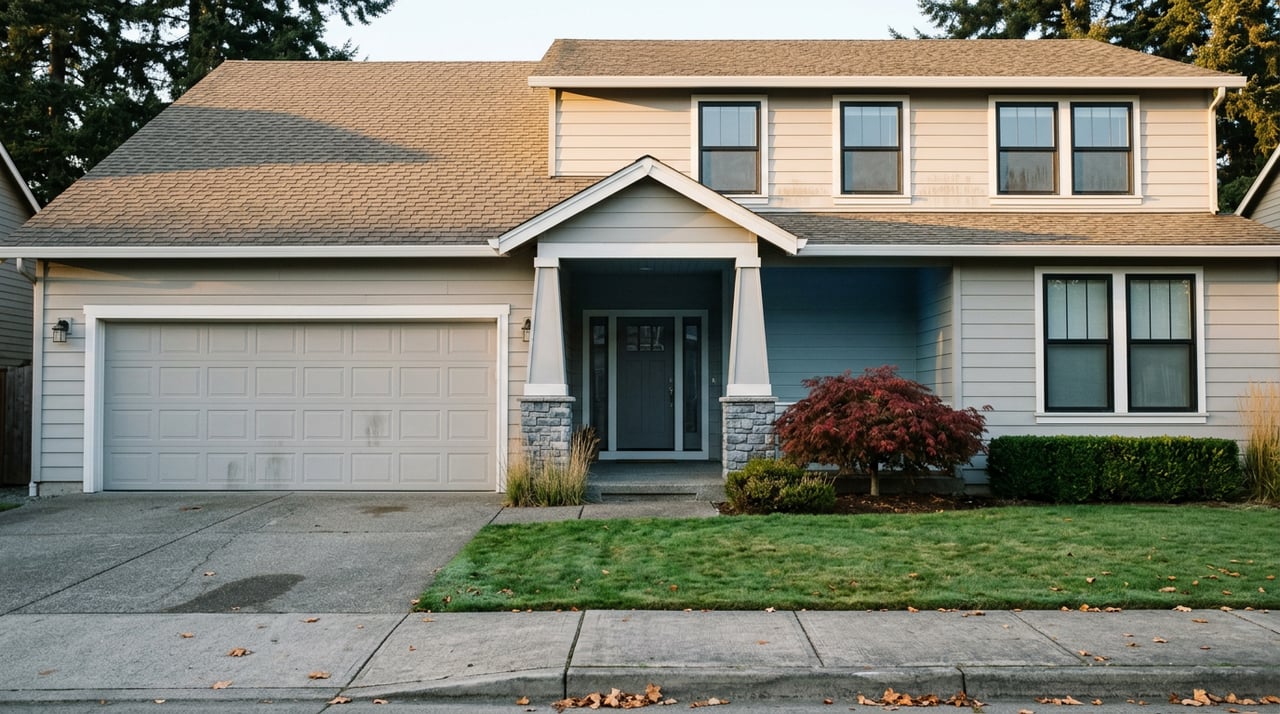
Why does a brand-new three-bedroom in Ridgefield Heights go pending in nineteen days while a nearly identical resale home two streets over sits for two months? Sellers ask their agents this question every week in Ridgefield right now, and most agents answer with the obvious line: new construction is winning because it's new. That's true, but it isn't the whole answer, and it isn't the part that actually helps a seller price their home correctly.
The real mechanism is quieter. It lives inside the financing paperwork, not the listing sheet, and it explains something stranger than slow days on market. It explains why two people can look at Ridgefield's housing data in the same month and walk away with two completely different numbers for what a home there costs.
The Same Month, Two Different Ridgefields
In May 2026, one widely used real estate portal reported Ridgefield's median sale price at $650,000, with homes averaging $279 per square foot and going pending in about 52 days. That same month, a separate Clark County brokerage's snapshot of active listings put the median list price at $800,250, average price per square foot at $381, and average days on market at 112.
Those aren't typos or rounding differences. They're two honest measurements of two different slices of the same city. Ridgefield's inventory splits into three real categories: production-builder homes in planned subdivisions on the south end of the city, country properties on one to ten acres along the northern and eastern edges, and custom or luxury homes near the Ridgefield National Wildlife Refuge that carry a premium for privacy and views. A dataset weighted toward fast-moving builder spec homes reads low on price and low on days on market. A dataset weighted toward custom acreage and refuge-adjacent estates reads high on both. Neither number is wrong. Neither number is the whole city.
If you're comparing Ridgefield to a portal median you saw last week, the first question isn't "is that number right." It's "which Ridgefield is that number describing."
The Discount That Never Shows Up In The Sale Price
Here's the part that catches resale sellers off guard, and it's the actual reason identical floor plans sell at different speeds.
Production builders in Ridgefield, including Pulte at Meadowview, Lennar at Ridgefield Heights, Richmond American at Seasons at North Haven, David Weekley at Greely Farms, and Toll Brothers at Quail Ridge, routinely offer temporary rate buydowns, closing cost credits, and design studio upgrade packages to win buyers. These offers change by community and by month, which is exactly why builders ask buyers to request them in writing rather than assume last month's flyer still applies.
A rate buydown or a closing credit doesn't touch the recorded sale price. The home still closes at full list. But it functions exactly like a price cut for the buyer, because it lowers their effective monthly payment or their cash to close. That means the "median sale price" you see on a portal already has some quantity of hidden discount baked into it, invisible to anyone reading the headline number.
A builder incentive worth even a few percentage points of the loan amount can make a $700,000 spec home feel, to a buyer's monthly budget, like a $670,000 home. The MLS never records that. The buyer's decision does.
This is why appraisers are trained to dig into concessions when they build comps. A resale seller who prices strictly off closed sales in the neighborhood, without checking whether those closings came with a builder credit attached, is comparing their asking price against numbers that were already quietly discounted before the ink dried.
Not Every Price Band Feels This The Same Way
The compression isn't uniform across Ridgefield, and that matters if you're deciding when and how to list.
Entry-level production homes cluster in the mid $400s to low $500s, typically 1,700 to 2,200 square feet with three or four bedrooms. Mid-size plans, often 2,300 to 3,200 square feet with flexible lofts or dens, land in the mid $600s and up. Premium neighborhoods with larger lots and single-level options start around $800,000 and run past $1 million.
A resale home priced squarely inside the $500,000 to $700,000 range is the one most likely to sit next to active spec inventory carrying a rate buydown or credit. That's the band where the invisible discount does the most damage to a seller's negotiating position, because a buyer comparing your home to a builder's quick-move-in unit is often comparing your full price against their discounted effective payment without realizing it.
Country acreage properties and custom estates near the refuge largely sit outside this pressure. There's no production builder competing at $1.2 million on ten acres, so that segment's days on market and pricing behave more like the higher, slower numbers in the brokerage snapshot than the faster, cheaper numbers on the portal.
Why This Is Especially True In Ridgefield Right Now
Two local facts explain why this dynamic is sharper in Ridgefield than in most Clark County cities this year.
First, Ridgefield is one of a small number of Washington jurisdictions, alongside places like Ferndale and La Center, that issues impact fee deferrals to builders without requiring a lien against the property. A state legislative audit found that deferral use statewide has been infrequent and concentrated in exactly these few cities, because most jurisdictions require a lien that builders find cumbersome. Ridgefield chose not to, which means builders here can defer paying impact fees until closer to a home's sale, improving cash flow and letting them build faster and price more aggressively than they might elsewhere.
Second, the infrastructure paying for all this new inventory just finished. The $30 million Pioneer Street widening and Discovery Drive roundabout project, funded in part through tax increment financing, reached substantial completion earlier this year, giving new subdivisions on the south end of the city a genuinely improved connection to I-5. The Port of Ridgefield has used the same financing tool to fund additional infrastructure around the I-5 interchanges and the waterfront, projecting roughly 3,190 construction jobs and $218.3 million in labor income over a 25-year window. The Ridgefield Family YMCA is expected to open near Pioneer Canyon Drive in late 2026, and Union Ridge Town Center, anchored by Costco, has brought additional commercial development to that same corridor.
None of that is decoration. It's the reason builders keep breaking ground in this specific pocket of Ridgefield rather than spreading evenly across the city, and it's the reason resale homes near that corridor are being pulled into direct comparison with brand-new construction in a way that homes on the north or east side of town simply are not.
What This Means If You're Listing In That Band
If your resale home falls in the $500,000 to $700,000 range and sits within a few miles of the Pioneer corridor, a few things are worth doing before you set a list price.
- Ask what active builder communities near you are currently offering. Incentive sheets change monthly, so request the current version in writing rather than relying on last quarter's promotion.
- Ask your agent or appraiser how recent nearby closings handled concessions. A closed sale at full price with a $20,000 credit attached is not the same comp as a closed sale at full price with nothing behind it.
- Lean into what spec inventory can't offer on day one: mature landscaping, finished outdoor living space, a flexible or nonexistent HOA, and a home that's been lived in rather than staged from a model.
- Consider a short-term rate buydown or closing credit of your own rather than a straight price cut, since it lets you compete on the buyer's monthly payment without resetting the comp for every other seller on your street.
Buyers cross-shopping Ridgefield against Camas or Battle Ground should keep the same idea in mind from the other direction. Camas commands a real per-square-foot premium tied to its schools and constrained supply, and Battle Ground trades I-5 convenience for more rural character and a slightly lower price floor. Ridgefield's position in the middle only holds if you're comparing like segments. Compare a Ridgefield spec home to a Camas resale and you're not measuring the same thing.
FAQ
Does new construction always lower resale values nearby? Not automatically, and not evenly. It compresses values most directly in the price band where builders are actively competing, generally $500,000 to $700,000 in Ridgefield right now. Acreage and custom homes outside that band are largely insulated.
How do I find out what incentives a builder is currently offering? Ask directly and get it in writing. Builder promotions on rate buydowns, closing credits, and upgrade packages change month to month and community to community, so a flyer from three months ago may no longer reflect what's on the table.
Should I wait until infrastructure projects finish before listing? The major piece, the Pioneer Street widening and Discovery Drive roundabout, has already reached substantial completion this year. The commercial buildout around it, including the YMCA and Union Ridge Town Center, is still filling in, which means the corridor's pull on nearby resale values is likely to keep evolving rather than settle immediately.
If you're weighing a resale listing against what's happening in Ridgefield's new-construction corridor, or trying to figure out which Ridgefield a median price you saw online is actually describing, Karen Higgins can walk through the current comps, including which ones carry hidden builder concessions, and help you price against the real competition instead of the headline number.