
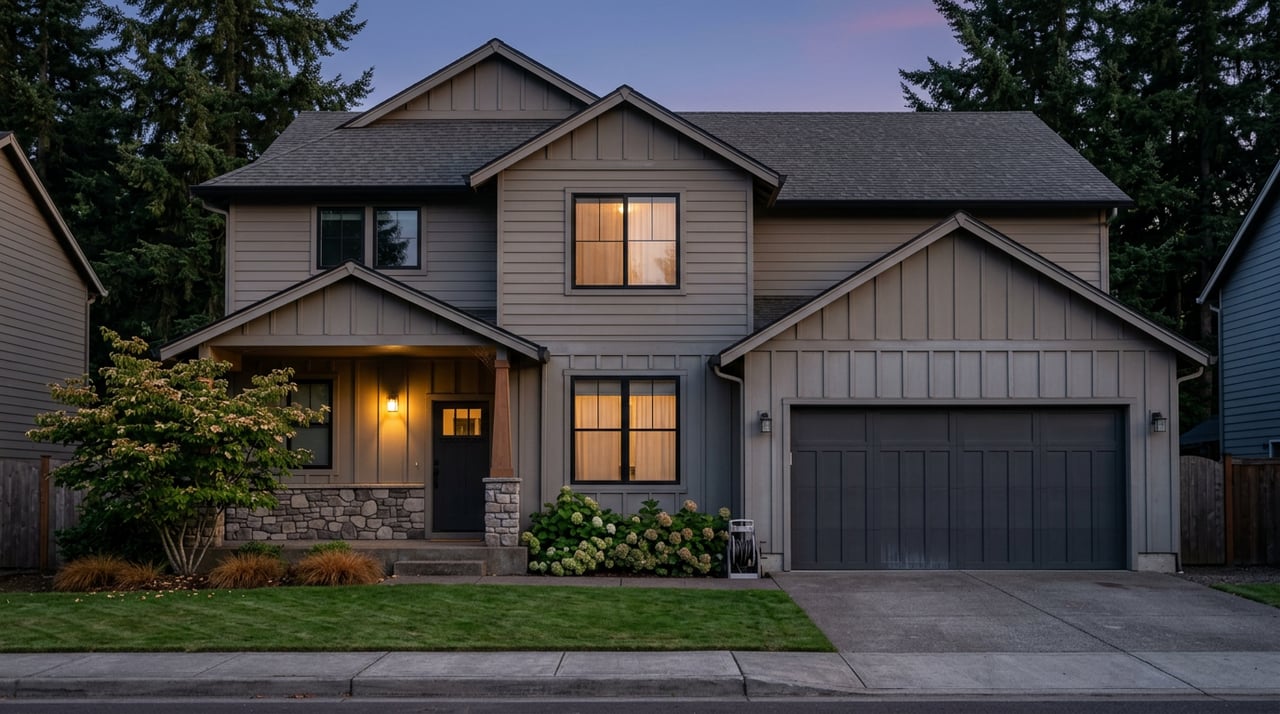
A Portland software engineer and a Vancouver, Washington homeowner cross paths at an open house in Felida. Both are looking at a $540,000 four-bedroom with an attached garage and a fenced yard. The Portland buyer has run the numbers everyone runs: no Oregon income tax on the Washington side, a home price that undercuts inner Portland, and a twenty-minute drive back to the job downtown. On paper, moving across the river looks like free money.
It isn't, not for everyone, and the difference between who gets the discount and who doesn't has almost nothing to do with which side of the Columbia River someone sleeps on. It has to do with where their paycheck is earned. That distinction is about to matter more, because Washington and Oregon are moving ahead with tolling on the I-5 bridge itself, and the group most likely to feel it is the same group already getting the least benefit from Washington's no-income-tax pitch: people who live in Vancouver but clock in across the river.
The Pitch Everyone Repeats
Washington charges no personal state income tax. Oregon's top marginal rate reaches 9.9% on income above $125,000 for a single filer or $250,000 for a couple filing jointly in 2026. Put those two facts side by side and the Vancouver sales pitch writes itself: buy on the Washington side, keep the Portland job market and restaurant scene, and skip the state's biggest tax line item.
Home prices reinforce the story. Vancouver's median has generally sat in the high $400s to low $500s through 2026, while Portland's has run somewhat higher, into the mid $500s. The gap isn't dramatic, but it's real, and when you add "zero income tax" on top of "cheaper house," the math looks settled before a buyer ever crosses the bridge.
The math isn't settled. It depends entirely on where the work happens.
The Nonresident Return Nobody Puts on the Brochure
Oregon taxes income earned from work physically performed inside the state, regardless of where the worker lives. A Vancouver resident who drives into a Portland office five days a week files an Oregon nonresident return (Form OR-40-N) and owes Oregon income tax on every dollar of those wages, at the same bracket rates an Oregon resident would pay. Living in Washington doesn't exempt that income. It only exempts income sourced from Washington, meaning wages from a Washington-based employer, self-employment income earned while physically working from a Vancouver home office, or investment and retirement income that isn't tied to an Oregon job in the first place.
That single distinction, wage source versus residence, is the whole hidden mechanism. It's also why two neighbors on the same Felida street can have completely different relationships with the "no income tax" pitch depending on where their employer's building sits.
There's a second layer that catches even more people off guard. The Portland metro area layers two additional taxes on top of state income tax, and both apply to nonresidents who earn enough in the right zip codes. The Metro Supportive Housing Services tax charges 1% on income above an inflation-adjusted 2026 threshold of $128,000 for a single filer, and it applies across the whole Metro district, which covers Portland, Beaverton, Gresham, Lake Oswego, Tualatin, Tigard, Hillsboro, Milwaukie, and the unincorporated parts of Multnomah, Washington, and Clackamas counties. Multnomah County adds a separate Preschool for All tax on top of that: 1.5% on taxable income between $125,000 and $250,000, and 3% above $250,000, again applied to nonresidents based on where the income is earned rather than where they live.
Here's the part that rewards paying attention to geography rather than headlines: Metro SHS follows the Metro boundary, but Preschool for All follows Multnomah County specifically. A Vancouver commuter whose office sits in Hillsboro or Beaverton, both inside Washington County and the Metro district, clears the Metro SHS threshold without ever touching the Preschool for All tax. A commuter whose office sits in downtown Portland doesn't get that option. Same commute distance, same bridge crossing, different tax exposure, purely because of which county the desk sits in.
Three Vancouver Households, Same Zip Code, Three Different Bills
| Household | Oregon income tax on wages | Metro SHS / Multnomah PFA (2026) | Daily I-5 toll exposure | Share of the "no income tax" pitch actually captured |
|---|---|---|---|---|
| Fully remote worker, Washington-based employer | None (income is Washington-sourced) | None | None for work | Full |
| Commutes to a Hillsboro or Beaverton office, earns $90,000 | Yes, full nonresident return | Under $128K threshold, likely none | Twice daily, every workday | Partial on wages, full on savings/investment income |
| Commutes to a downtown Portland office, earns $200,000 | Yes, full nonresident return | Metro SHS applies (roughly $720/year on income above the threshold); Multnomah PFA also applies | Twice daily, every workday | Minimal on wages, same bracket exposure as an Oregon resident |
The pattern holds across every version of this comparison: the "zero income tax" benefit is real and substantial for remote workers, Washington-employer workers, and retirees living on investment or pension income. It shrinks toward nothing for anyone whose paycheck originates from a Portland-area employer, because Oregon taxes that income at the source regardless of the commuter's mailing address.
The house doesn't decide who gets the tax break. The employer's address does.
The Bridge Is About to Send a Second Bill to the Same Group
Tolling on the existing I-5 twin bridges is moving forward as part of the Interstate Bridge Replacement Program, and the timeline has shifted more than once this year. Washington Governor Bob Ferguson announced in March 2026 that total project costs had climbed to $7.65 billion, pushing construction of the new span to 2028, and pointed to tolls reaching as high as $3 per crossing to help close a roughly $2 billion funding gap. A traffic and revenue study from the project's tolling subcommittee, completed back in 2024, had modeled scenarios ranging from about $1.50 to $3.55 per one-way trip depending on time of day. A retired civil engineer, writing in 2025 for a coalition opposed to the current bridge design, warned that if costs kept climbing the way they had been, tolls could eventually reach $20 per crossing at peak hours. Nobody involved treats that upper number as the base case, but the spread between $3 and $20 tells you how unsettled the pricing still is.
The start date is just as unsettled. Some 2026 reporting describes tolling beginning on the current bridges this year, ahead of construction, under a strategy the project calls pre-completion tolling. Other reporting from as recently as June 2026 ties tolling to the newly pushed 2028 construction start. The federal environmental review cleared its final hurdle on July 1, 2026, which removes one obstacle, but the toll rate itself still hasn't been finalized by the Oregon and Washington transportation commissions, and low-income discount policy is still under discussion rather than settled.
What is settled: whoever drives across that bridge for work will pay it twice a day, every workday, for the length of their commute. That's the same population already getting the smallest share of the income-tax benefit, the daily Portland commuter. When Washington's legislature first authorized bridge tolling in 2023, State Representative Greg Cheney of Battle Ground offered an amendment to exempt Washington residents working in Oregon from the toll entirely, arguing they shouldn't be taxed twice for making the same trip. Whether any version of that exemption survives into the final toll structure is still an open question as the commissions finalize rate scenarios this year.
There is one practical release valve. Washington law currently prohibits tolling on the Washington side of I-205, and Oregon's own transportation officials have said they have no plans to add tolls there either. That makes I-205 the toll-free alternative once I-5 pricing goes live, at the cost of a longer drive for most Vancouver neighborhoods.
What This Actually Changes for a Buyer
None of this makes Vancouver a bad move. It changes which Vancouver move makes sense for a given household. A remote employee or a worker at a Washington-based company captures the income-tax advantage cleanly and never pays the new toll for commuting purposes, which means the traditional pitch, lower home price plus no income tax, holds up close to full strength. Those buyers have room to consider a wider range of Clark County, from downtown Vancouver's walkable core out to Salmon Creek or Hazel Dell, since a daily bridge crossing isn't part of the calculation.
A household anchored to a downtown Portland job is working with a smaller net advantage, since Oregon collects on that income at the source and the household is about to add a toll on top of a commute they were already making for free. For that buyer, the honest comparison isn't Vancouver versus Portland on price alone. It's whether the space and price difference on the Washington side still outweighs a paycheck that Oregon taxes at full resident rates plus a toll that didn't exist when they signed their last lease.
For buyers weighing a Metro-area job outside Multnomah County specifically, Hillsboro, Beaverton, and similar Washington County, Oregon employers, the math sits in the middle: full Oregon wage tax applies either way, but the Preschool for All layer doesn't, and that's worth knowing before assuming every Portland-area job carries the same tax weight.
If you're trying to run this comparison against an actual address, whether you're coming from Portland, staying local in Clark County, or weighing a move-up purchase in Felida, Salmon Creek, or downtown Vancouver, Karen Higgins can walk through the specific neighborhoods, commute patterns, and price bands that make sense for your situation. Reach out to request a free home valuation and local market consultation before you assume the math works the way the ads say it does.
FAQ
Does the new bridge toll apply if I work from home most days? Based on how tolling is structured on comparable Washington facilities, tolls are charged per crossing, so a hybrid worker who only drives into Portland one or two days a week would only pay on the days they actually cross, not a flat daily or monthly rate.
Will there be a discount for lower-income commuters? Washington and Oregon transportation officials have discussed a low-income toll discount program as part of the bridge project, along with exemptions for vehicles like school buses and emergency vehicles, but as of mid-2026 no final discount structure or exemption list has been adopted for regular commuter vehicles.
Is the toll definitely starting in 2026? The timeline has moved. Earlier 2026 reporting pointed to tolls beginning on the current bridges this year, ahead of full construction, while more recent reporting tied to the project's pushed construction start suggests 2028. The state transportation commissions have not finalized a toll start date or rate as of this writing.
Does this mean I should just avoid a Portland-area job and buy in Vancouver anyway? That's a personal and financial decision beyond what any market data can answer, but it's worth running your specific employer's location, your income level, and your expected commute pattern against the numbers above before assuming the Vancouver tax pitch applies to your paycheck the way it applies to a remote worker's.