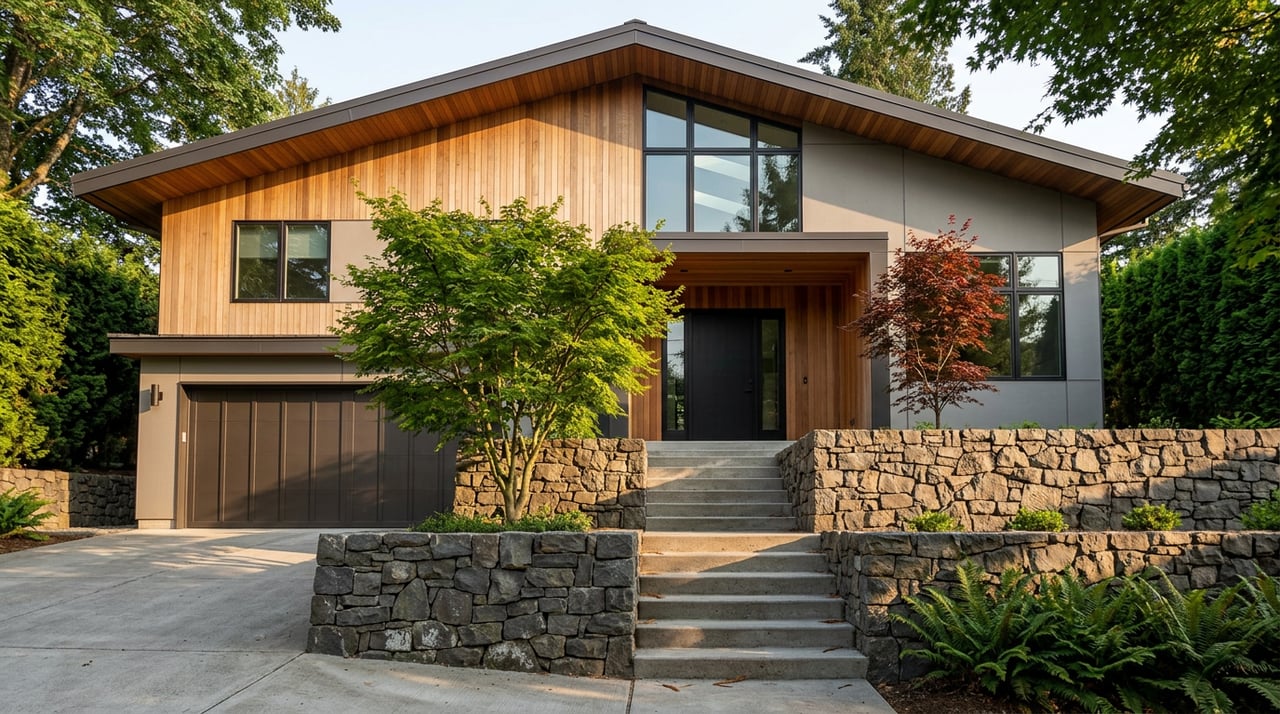
Two showings, same week, same $840,000 price point. The first is a 1990s custom on the north slope of Prune Hill, big windows, a view of Lacamas Lake and the Cascades, a kitchen that hasn't been touched since Clinton was in office. The second is a Grass Valley build finished last spring, smart thermostat, tankless water heater, builder warranty still active, no view at all beyond the neighbor's fence. Same money. Same city. Buyers walking through both would be forgiven for wondering if the listing agent typed the wrong price on one of them.
Neither agent made a mistake. This is just what happens when a single median price gets asked to describe a city built on a collapsed volcano, where elevation, era, and a handful of gated cul-de-sacs do more to set price than square footage ever will.
The Number Everyone Quotes Is an Average of Very Different Things
Camas real estate coverage tends to lead with one number. Redfin puts the citywide median sale price at $826,000 over the three months ending May 2026, down 4.3 percent from the same stretch a year earlier. Movoto's most recent figure, updated July 25, 2026, has the June 2026 median at $839,900. Those two numbers sit close enough to agree on roughly where "typical" lands right now, somewhere in the low $800,000s.
Where the sources stop agreeing is speed. Redfin reports homes selling in around 43 days over that same three-month window, up from 17 days a year earlier. Movoto's number for June 2026 shows 121 days on market, up from 68 days last year. Those are not measuring the same thing. Platforms differ in whether a relisted home resets its day count or carries it forward, so the absolute figures aren't comparable to each other. But both point the same direction with a similar magnitude: homes in Camas are taking roughly twice as long to sell as they did a year ago.
That single fact matters more than the median itself, because it changes negotiating leverage differently depending on which of Camas's sub-markets a buyer is actually shopping.
Prune Hill Isn't One Neighborhood. It's Two, Facing Opposite Directions
Ask a local agent where the money is on Prune Hill and the honest answer is that it depends which way the house faces. The southern ridges catch front-row views of the Columbia River and Mount Hood. The northern slopes look toward the Cascade Range, Mount St. Helens, and Lacamas Lake instead. Both count as "Prune Hill" on a listing sheet. Both carry a premium over the Clark County average. But they're selling to different buyers chasing different skylines, and pricing them as one interchangeable category is how a buyer ends up overpaying for a view they didn't actually want.
Then there's the outlier that quietly drags any "Prune Hill average" somewhere it doesn't belong: Dawson's Ridge. This gated community in southwest Camas overlooks both the Columbia River and Portland, with homes running 3,000 to 5,000 square feet, built by regional names like Affinity Homes, Glavin Homes, MC Custom Homes, and Cascade West Development. The NW Natural Parade of Homes chose Dawson's Ridge as its site in 2019, which tells you the tier of construction on display there. As of June 17, 2026, the community's active listings carried a median list price of $3,770,000. Fold even one Dawson's Ridge sale into a "Prune Hill median," and the number stops describing anything a typical buyer will actually experience.
What Three Camas Sub-Markets Actually Look Like Right Now
| Sub-market | Character | What sets the price |
|---|---|---|
| Downtown / Crown Park | 1920s craftsman bungalows, walkable to the historic district | Age and vintage charm, smaller lots |
| Grass Valley | Newer subdivisions built out heavily by D.R. Horton | Recency of construction, builder warranties, fewer view lots |
| Prune Hill (standard) | 1990s-2000s custom homes on the volcanic ridge | Which slope the home faces and how much of the view it captures |
| Dawson's Ridge | Gated, custom, Parade of Homes pedigree | Scarcity and exclusivity, not comparable to the rest of the hill |
Notice what's missing from that table: a single row that represents "Camas." There isn't one. A buyer with $850,000 to spend is choosing between a walkable historic bungalow, a warrantied new build with no view, and a dated custom home with the view that made Prune Hill famous in the first place. Those are three different trades, not three flavors of the same house.
The Slowdown Doesn't Hit Every Sub-Market the Same Way
A market where homes sit twice as long gives every buyer more room to negotiate than they had a year ago. But that room shows up differently depending on where you're shopping.
In Grass Valley, pricing tends to follow builder incentives as much as resale comps, since so much of the inventory is new construction from the same handful of production builders. A slower market there often means rate buydowns or closing cost credits rather than a straight price cut, because builders protect their base price to avoid resetting appraisals for everyone else in the subdivision.
On Prune Hill, a slower market usually means more time to actually compare which slope, which view corridor, and which decade of construction you're paying for, since these homes rarely sit in tidy comp sets the way production homes do.
At the very top, in something like Dawson's Ridge, days on market has always run long relative to the rest of the city, because there are only ever a handful of buyers shopping in that price range regardless of the broader cycle. Two active listings with an average of 18 days on market as of mid-June 2026 isn't a market cooling. It's a market that was never fast to begin with.
A buyer who calls me and says "I saw the Camas median, so I know what my budget gets me" is the buyer I want to talk to first. The median tells you almost nothing about which of these three markets you're about to enter, and that's exactly where a wrong assumption costs the most money.
How to Shop Camas Without Comparing Apples to Zip Codes
- Ask which direction a Prune Hill home actually faces before comparing it to another Prune Hill listing. South-ridge river views and north-slope Cascade views are priced differently for a reason.
- Confirm the school district boundary for any address before writing an offer. Some addresses carry a Camas ZIP code but fall outside the Camas School District entirely, and that boundary line can matter more to resale value than the ZIP code on the envelope.
- Separate new-construction pricing from resale pricing when you build your comp set. A Grass Valley new build and a 1990s Prune Hill custom will never comp cleanly against each other, even at the same price point.
- Check whether the HOA covers a standard neighborhood association or a gated-community amenity package. The dues, and what they buy, are not the same across Camas subdivisions.
- Treat any listing inside a small gated enclave like Dawson's Ridge as its own market. With only a handful of active listings at any given time, a single sale can swing the average by hundreds of thousands of dollars.
Downtown Camas still gives buyers a reason to pay for proximity over square footage. The Camas Farmers Market is relocating for the first time in nearly two decades, a reminder that the historic core keeps drawing foot traffic even as the market cools elsewhere in the city. That kind of walkable pull is part of what a Crown Park bungalow buyer is paying for, and it has almost nothing to do with what a Grass Valley or Prune Hill buyer is paying for.
FAQ
Is Prune Hill always the most expensive place to buy in Camas? Usually, but not by a fixed amount, and not evenly across the hill. A north-slope home facing the Cascades and a south-ridge home facing the Columbia River can carry meaningfully different price tags even at similar square footage, and a gated enclave like Dawson's Ridge operates on its own pricing entirely.
Why did the median price fall while days on market went up? Those are two separate signals. A falling median can reflect a shift in what's selling, more mid-range homes closing relative to luxury ones, rather than existing homes losing value dollar for dollar. Rising days on market reflects buyers taking longer to commit, which is a demand-side signal, not necessarily a price-side one.
Should I trust the median price I saw on a national portal? Treat it as a starting point, not a budget. As shown above, two major platforms landed within about two percent of each other on Camas's overall median for mid-2026, so the price signal is reasonably stable. The days-on-market figure is where platforms diverge sharply, so lean on a local read of that number rather than any single site's count.
If you're comparing Camas neighborhoods against each other and want a read on what a specific address is actually worth given its slope, school boundary, and construction era, Karen Higgins has spent decades watching these sub-markets move independently of each other. A free home valuation and local market consultation is the fastest way to find out which of Camas's three markets your budget actually belongs in.